- Stepper Motor
- Brushless Motor
- DC Motor
- AC Motors
- Linear Servo Motors
- Servo Motor
- Planetary Gearbox
- Couplings
- Linear Guide
- Linear Slides
- Tables
Did you know that the first Stepper Motors were made in 1905? They are commonly referred to as a Step Motor, Stepper Motor, and Stepping Motor. Even though 3 different terms are used, they all have the same meaning. Stepper Motors are used in many places in everyday life. Most watches have a stepping motor in them. Many 'analog' clocks actually have a step motor controlling the hands. That makes it a 'digital' clock after all. There are over 200 stepper motor manufacturers around the world. What separates Anaheim Automaiton between us and the rest of them is our high quality products, informative website, helpful and knowledgable application engineers, and our great customer service.
Stepper Motor Windings - there are three main types of Stepper Motor Windings, the Unipolar Stepper Motor, Bipolar Stepper Motor connected in series, and Bipolar Stepper Motor connected in parallel. Most hybrid stepper motor designs have coils no matter which winding configuration is made. The only difference between the different stepper motor windings is how the wires are connected internally to the windings. If 8 wires are brought out, then the stepper motor can be connected by any of these three winding methods.
Brushless DC Electric Motors, commonly called a Brushless Motor is commutated electronically by a controller board. In a BLDC motor, permanent magnets are embedded in the rotor surrounded by electromagnets in the stator. The rotor does not make any contact with the stators so the life is mainly determined by the life of the bearings. An electronic BLDC Controller is required to control a Brushless DC Motor. Anaheim Automation offers a wide range of Brushless Controller products including brushless controller integrated circuits, speed controller boards. This line will continue to be expanded to provide a solution to almost every Brushless Motor application.
Since around 2000, the price for BLDC motors came down dramatically. With low cost manufacturing around the world, the Brushless Motors started to become more widely used in applications that previously used other technologies. The Brushless Motor is especially being used in place of the typical DC Motor that contains brushes. The BLDC motors offer higher efficiency, reliability, reduced noise, lower EMI emissions, and have a much longer lifetime when compared to DC motors.
If you use a DC Motor or DC Motors today, you have Michael Faraday to thank for figuring out how to convert electrical energy into motion in 1821. He didn't make the DC Motor alone though — he set out to prove what Oersted and Ampere hypothesized and proved it by having an electric wire rotate around a magnet, then a magnet rotate around an electric wire. Thus almost 200 years later, Anaheim Automation has hundreds of DC motors to offer for your motion control applications. Our DC motors are designed to offer you extremely high value — maintaining high quality and performance but always driving to keep costs to a minimum. Check out our broad DC Motor product line.
AC Motors are probably the most common type of motor. You will find the AC Motor used in many different applications. In your house you probably have ac motors in most of your electronic appliances. The best feature of an AC Motor is that you can connect the power from your AC outlet directly to the motor and it will turn. There is not an additional need for a power supply - the AC Motors work by just connecting them to the AC power.
The Linear Servo Actuator is comprised of a forcer and a magnetic way. The Forcer is the dynamic aspect of the system which also carries the load and contains coils, Hall Effect and thermal sensors. The magnetic way is comprised to two rails that on each side contain opposite polarity rare earth magnets.
Now, how do these linear servo motors work? If you have any understanding of rotary motors well simply take it apart, unwrap it and flatten out the stator and instead of producing rotary motion it will produce a linear motion. The forcer of linear servos generally has two coils that are out of phase with each other, so when the two magnetic fields interact, the combinations of attraction and repulsion cause the linear actuator servo to move in one direction.
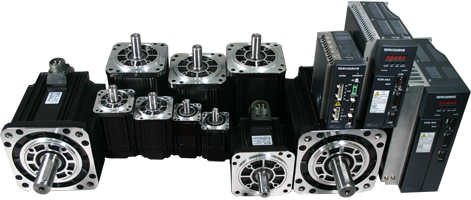
Anaheim Automation has an extensive line of servo system for your motion control needs, this includes a servo motor, servo drive (servo amplifier) and a servo controller. We have a wide array of servo motors and their mating servo drivers (servo amplifiers) that range from under 200 watts, up to 5,000 watts of power with a speed rating of 1,000 to 3,000 rpm. A brushless dc servo motor is more commonly used for power ratings of 1,000 watts and below, while an ac servo motor is used for power ratings of 1,000 watts and above.
Some servo motor basics include an incremental 2500 count per revolution encoder, with a 60-180mm square flange, and are equipped with a high energy Neodymium-Iron-Boron magnet. These ac servo motors have optional speed ratings, oil seals, brakes, and shaft ends.
Servo drives are a closed loop tracking system which is used for mechanical movements. A servo driver is designed to switch among different servo motor control modes for a more convenient and flexible operation, thereby controlly position, speed and torque all in one unit.
Planetary gearboxes are manufactured standard with bevel gears, with optional helical gears, shafts and bearings in an enclosed housing. A couple advantages of using the helical gear over the bevel gear are noise reduction, and increase torque, but this will decrease the efficiency of the gearbox. The planetary gear rotates around a central sun gear, which resembles a solar system. These gear boxes increase torque and inertia by reducing the high input speed. Due to the decrease on the input speed, the planetary gear reducer is also known as a gear reducer, gear reduction or reduction gearbox.
If your application is very limited in space then the gear reducers also come as a right angle gearbox.
These gearboxes can be purchased with a motor to create a gearbox motor or a gear motor. The gearmotor eliminates the hassle of combining the planetary gearbox with the gear motors.
As an alternative to the planetary gearbox, spur gears in a spur gearbox is also available.
Anaheim Automation provides an extensive selection of couplings with a large array of bore/keyway combinations. We have several different couplings to choose from such as; flexible Couplings and jaw couplings. We offer the Jaw Couplings in either L-Type of KTR-Type and the flexible couplings are offered in clamp type of set screw type. We have several different bore diameters ranging anywhere from .197 inches all the way up to .375 inches all fully interchangeable to mix and match for your motion control needs. With Anaheim Automations Couplings you are not only given several options but you are also receiving reliability, with a 26.3 in/lb maximum torque rating these couplings can handle any electrical motor application.
The purpose of Rigid Couplings is to join two pieces of rotating matter. By carefully selecting the correct coupling for your application substantial savings can be made by reducing maintenance costs and downtime.
Shaft couplings are used in industrial equipments such as; pumps, gear boxes, compressors, blowers, mixers, and conveyors. Jaw couplings can consist of two hubs and a spider (also referred to as a cushion) which is made up of NBR SOX rubber. NBR SOX rubber is a flexible elastomeric material that is oil resistant, and resembles natural rubber in resilience and elasticity. Flexible Shaft Couplings are normally one piece and have various slits along the length of the motor coupling which allow for misalignments.
Anaheim Automation carries an extensive line of Linear Rails anywhere from 15mm all the way up to 4m. Linear guide rails consist of two main parts the rail itself and the carriage but bearings also play a big roll in the movement of the guide rail. The rail is the axis along which the carriage will be moving and the carriage is the actual dynamic device that will be bearing the load. Anaheim Automation offers two types of bearings; ball-bearings are meant for smooth lower load applications while dovetail bearing are meant for smooth heavier load applications. The bearing act as a buffer between the rail and carriage, these bearings mitigate the friction produced by the carriages movements, yielding a smoother movement. The Linear ball bearing slides are the most frequently used linear rails, these linear rails can be found in; delicate instrumentations, robotics, cabinetry, and high end appliances. Dovetail slides are typically constructed from cast iron and have a much larger surface area than most bearing blocks. Much more force is required to move this type of linear rail, resulting in much lower acceleration rates but make up for it in their load capacity. Dovetail slides are more resistant to shock in comparison to other bearings; they are immune to chemical, dust and dirt contamination making them perfect for a heavy machinery setting. Slide rails can be powered through inertia, manually or power driven all depending on your application.
Linear Systems are composed of completely linear items, or a mix of rotational and linear items. A motor and a ball screw can be used to translate rotary motion into linear motion. Anaheim Automation offers a wide range of XY tables, linear slides, linear tables, and linear stages.
Anaheim Automations is the perfect place to find your linear system; we have a wide selection of Linear Tables to match your motion control needs. Our Linear Actuators come with a wide array of options such as; screw pitch, travel length, limit switches, block types and different dynamic load thresholds.
Our XY Table uses closed loop stepper motors and drivers along with encoders and limit switches. Linear Systems are integrated with a lead screw shaft and slide block; the lead screw shaft has several threads along the shaft (Accuracy measured by screw pitch) for the slide block to move up and down on, the slide block acts like a nut on the lead screw, the slide block is also integrated with threads which make motion possible. The lead screw of our linear stage is attached to a stepper motor through a motor bracket and coupling, this stepper motor is what rotates our lead screw and allows our slide block to move up and down the lead screw. All our linear systems come with a dust cover to protect and promote motion control optimization.
All these components of the XY stage come in several sizes, position reliabilities and torque, weight, speed thresholds which are sure to fit your motion control needs. Anaheim Automation is a one stop shop and has all the parts for your motion control needs.