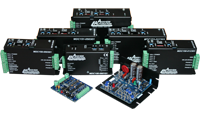
Brushless Drivers/Controllers

Anaheim Automation's Brushless DC Controllers are designed for high-volume OEM applications, keeping a low unit cost as the primary objective. Covering a wide range of motors, these quality controllers are available in input power ranges from 6-50VDC or 85-135VAC. Choose from 0-5VDC analog input control, or simply turn a potentiometer - it's that easy! Providing peak power up to 1500 Watts and peak current up to 60Amps, these brushless DC controllers deliver unsurpassed performance and quality, at an affordable price! For information on a custom BLDC controller, contact an Anaheim Automation Applications Engineer.


  • Input Ranges: 6 to 50VDC
  • Max Power: 24 to 250 Watts
  • Peak Current: 3 to 10Amps
  • Low-Cost Speed Controllers
  • Covers a Wide Range of Motors
  • Printed Circuit Board Style
  • Overcurrent and Undervoltage Protection
  • Input Ranges: 10 to 50VDC or 85 to 135VAC
  • Max Power: 75 to 500 Watts
  • Peak Current: 5 to 60Amps
  • Low-Cost Speed Controllers
  • Covers a Wide Range of Motors
  • Huge Selection, Six Different Series Offered
  • Printed Circuit Board and Enclosed Styles
  • Over-Current and Under-Voltage Protection
  • Input Ranges: 20 to 50VDC, or 85 to 135VAC
  • Max Power: 750 to 1,500 Watts
  • Peak Current: 15 to 60Amps
  • Low-Cost Speed Controllers
  • Covers a Wide Range of Motors
  • Three Different Series Offered
  • Enclosed Styles
  • Over-Current and Under-Voltage Protection
Fundamentals of Brushless Drivers/Controllers
  • Brushless Drivers/Controllers - How are Brushless Drivers-Controllers controlled
How are Brushless Drivers/Controllers controlled
Most Brushless Drivers/Controllers need a controller/driver to run. There are many different types of controllers/drivers that are manufactured around the world for different applications. Many come with different options and can be custom made. Most are referred to as Electronic Speed Controller (ESC).

In Brushless Drivers/Controllers, either a Hall Effect Sensor or the Back EMF (Electromotive Force) is used to run the motor. The Hall Effect uses three hall sensors within the motor to help detect the position of the rotor. This method is primarily used in speed detection, positioning, current sensing, as well as proximity switching. The magnetic field changes in response to the transducer that varies its output voltage. A feedback is created by directly returning a voltage since the sensor operates as an analogue transducer. The distance between the Hall plate and a known magnetic field can be determined with a group of sensors, in this case, three, and the relative position of the magnet can be deduced. A Hall sensor can act as an on/off switch in a digital mode when combined with circuitry.

The Back EMF, also known as the Counter-Electromotive Force is caused by a changing electromagnetic field. In a Brushless Motor, the back EMF is a voltage that occurs where there is motion between the external magnetic field and the armature of the motor. In other words, the voltage is developed in an inductor by and alternating current or pulsating current. At every moment, the polarity of the voltage is the reverse of the input voltage. This method is commonly used to measure the motor’s position and speed indirectly.
© 2011 Anaheim Automation, Inc. - All Rights Reserved