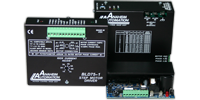
Stepper Drivers

Anaheim Automation stepper drivers are offered in a wide range of voltages, current and steps per revolution. Customers are impressed with Anaheim Automation designs, in that they provide outstanding motor performance. Offered in High-Performance Bilevel (Half-Step), Microstep and Line-Powered designs, Anaheim Automation has the right stepper driver for your automation requirements. Taking a system design budget into consideration, Anaheim Automation manufactures stepper drivers in several packaging styles, making them the most cost-effective stepper driver choice!


Driver Type: 110VAC or 220VAC Input
Current Range: 0.5 to 12.5 Amps
• Bilevel, Microstep and Line-Powered Drivers
• PCB, Modular and Enclosed Packaging Styles
• Offered as One to Four-Axis Units
• Driver, Power Supply in Fan-Cooled Packages
Driver Type: DC Input
Current Range: 0.2 to 12.5 Amps
• High-Performance, Bilevel and Microstep
• Also Available are L/R and Legacy Drivers
• PCB, Modular/Enclosed Packaging Styles
• Offered as Single-Axis Units
• Requires DC Power Supply
Driver Type: Transformer - AC Input
Current Range: 1.0 to 10.0 Amps
• Bilevel and Microstep Drivers
• PCB, Modular/Enclosed Packaging Styles
• Offered as Single-Axis Units
• Requires Transformer
  • Stepper Drivers - Types
  • Stepper Drivers - Environmental Considerations
  • Stepper Drivers - Wiring
  • Stepper Drivers - Applications
  • Stepper Drivers - Mounting
  • Stepper Drivers - Customization
  • Stepper Drivers - Accessories
  • Application Note - Flexibility is the Key to Successful Automation
  • Application Note - Microstep Drivers Head Out to Sea
Stepper Drivers types
Stepper Drivers with 110VAC or 220VAC Input The Stepper Drivers product line is supplied in a wide range of voltages, current and steps per revolution. Customers are impressed with Anaheim Automation's designs, in that they produce outstanding motor performance. Offered in High-Performance Bilevel (Half-Step), Microstep and Line-Powered designs, Anaheim Automation has one of the most fitting Stepper Drivers for your automation requirements. Taking a system design spending budget into consideration, Anaheim Automation manufactures its Stepper Drivers products in a number of packaging styles, making them the most cost-effective Stepper Drivers selection in the industry!

The Stepper Drivers line offers products that are available in a few different inputs (model dependent): 110 VAC or 220 VAC Input, DC Input and AC Input (with transformer). Anaheim Automation manufactures a large variety of Stepper Drivers Packs for customers requiring a 110VAC or 220VAC input. These units contain Stepper Drivers or multiple Stepper Drivers, with a matched up power supply, and are packaged on an open-frame chassis or in an enclosure. Available in one, two, three or four-axis configurations, with bilevel or micro-Stepper Drivers(s) in current ranges of 0.5 to 12.5Amps, with a power capacity of up to 800 watts (model dependent). Also included in this item offering is a 10Amp Line-Powered Stepper Drivers. Most popular and typically in stock at all times are the MLA10641 Stepper Drivers and the DPS32001, DPD72001XCE, and DPY50001 Stepper Drivers Packs.

There are two current ranges to choose from in the 110VAC and 220VAC Input when it comes to the Stepper Drivers product line: 2.6-7.0 Amp and the 7.1-12.5 Amp range. Anaheim Automation manufactures a large variety of Stepper Drivers Packs for customers needing a 110VAC or 220VAC input. This model contains Stepper Drivers with a matched power supply, and is packaged in an enclosure. Available in one, two, three or four-axis configurations, with a bilevel or microstep Stepper Drivers in current ranges of 0.5 to 12.5Amps, with a power supply capacity of up to 800 watts. Also included in this product offering is a 10Amp Line-Powered Stepper Drivers.

Stepper Drivers can be produced by Anaheim Automation for a variety of applications requiring a DC input. This Stepper Drivers product line is offered as single-axis units in open-frame and enclosed modular sheet metal packaging variations. Bilevel, micro-stepper and L/R drive types are available, making them compatible with a wide range of stepper motors. Most popular and typically in stock continually are the MBC15081, MBC25081TB, MBC05641, MBC121010, and MBC082561 Stepper Drivers products. If the request requires a compact Stepper Drivers for a small stepper motor in the 0-2.5 Amp range, examine Stepper Drivers models such as the MBC158, MBC15181, MBC25081 and MBC25081TB. This series of Stepper Drivers use microstep drive technology. All but the MBC15181 Stepper Drivers are built in a small sheet metal package. The low-cost MBC15181 Stepper Drivers model is a printed circuit board style.

Consider the MBC05641, MBL536, MBL600, M6R7, and the MBD45021-75 models if an application needs Stepper Drivers in the 2.6-7.0 Amp range. Stepper Drivers in this series is modular, which means they are assembled in small sheet metal enclosures. Featured in this series is the popular divide-by-64 microstep, 1-5Amp Stepper Drivers model MBC05641. A bilevel Stepper Drivers for instance the MBL536, MBL600 and L/R-type Stepper Drivers, model M6R7, which are our older "legacy" products are also offered. The MBD45021-75 is an "highest rated" specialty Stepper Drivers specifically designed to dramatically enhance torque/speed output in 24 to 40 volt systems.

Anaheim Automation offers Stepper Drivers that is economical and is designed to cover a wide range of stepper motors. When an application requires Stepper Drivers in the 7.1-12.5 Amp range, look at the MBC12101, MBC082651, and the BLHP101 Stepper Drivers models. The MBC12101 Stepper Drivers absolutely are a fixed divide-by-10 micro-Stepper Drivers with an output capacity of 1.5 to 10 Amps. The MBC082561 Stepper Drivers uses selectable divisors of up to 256 allowing for a very wide range of microstepping options. The older "legacy" high-performance bilevel Stepper Drive, model BLHP101, is a board-level product more commonly used in electrical panels or other comparable enclosures.

Stepper Drivers manufactured by Anaheim Automation are conveniently obtainable for applications requiring an AC input. These Stepper Drivers models require a transformer (purchased separately), and are usually available in printed circuit board and modular Stepper Drivers styles. Offered in two current ranges of 2.6 to 7.0Amps and 7.1 to 12.5Amps, these Stepper Drivers models are compatible with a combination of 4, 6 and 8-lead stepper motors. Some models utilize the bilevel drive technique, which does not create EMI, RFI, and motor heating that is associated with chopper Stepper Drivers. Also in this product line is the popular micro-Stepper Drivers, MBC10641 that offers eight selectable divisors: 1, 2, 5, 8, 10, 16, 32, and 64. Most popular and commonly in stock at all times are the BLD75-1, TM4500, and MBC10641 Stepper Drivers models.

Anaheim Automation manufactures a variety of Stepper Drivers models for buyers requiring AC inputs, in the 2.6-7.0 Amp current range. The economical board-level TM4500 and TM4500-80 Stepper Drivers series has an output capacity of 1 to 4.5 Amps. The TM4500-80 doubles the voltages, thus creating better performance at higher speed ranges. The very popular BLD75 and BLD75-1 Stepper Drivers series has an output capacity of 1 to 7 Amps, meeting a wide range of stepper motors. The BLD75-1 Stepper Drivers are a separate Stepper Drivers, while the BLD75 Stepper Drivers are sold as a replacement Stepper Drivers in Stepper Drivers Packs. All models in this series utilize the bilevel drive technique, they will not create EMI, RFI, and motor heating that is associated with a chopper Stepper Drivers. These Stepper Drivers series require a transformer, that is purchased separately. Additionally, Anaheim Automation's popular and cost-effective MBC10641 Stepper Drivers are excellent for customers requiring AC inputs, operating in current ranges regarding 1.5 to 10 Amps. This single-axis microstep Stepper Drivers requires a transformer, which is purchased separately. The MBC10641 Stepper Drivers offers eight selectable divisors: 1, 2, 5, 8, 10, 16, 32, and 64. It is compatible with a wide range of 4, 6 and 8-lead stepper motors.

Please NOTE: If you're looking for matched components for your Stepper Drivers system, look at Anaheim Automation's integrated Stepper Drivers/motor/controller models, or Stepper Drivers Packs.
Stepper Drivers Environmental Considerations
The following environmental and safety considerations are to be observed during all phases of operation, repair and service of Stepper Drivers system. Failure to comply with these precautions violates safety standards of design, manufacture and intended use of the Stepper Drivers and motor. Please note that even well-built Stepper Drivers products operated and set up incorrectly, can be hazardous. Precaution must be observed with the user with respect to the load and operating environment. The customer is ultimately accountable for the proper selection, installation, and operation belonging to the Stepper Drivers and motor system.

The atmosphere in which Stepper Drivers are used must be favorable to good general routines of electrical/electronic equipment. Never operate the Stepper Drivers in the presence of dust, vapor, flammable gases, or moisture. For outdoor use, the Stepper Drivers and motor must be guarded from the elements by an adequate cover, while still providing adequate air flow and cooling. Moisture might result in an electrical shock hazard and/or stimulate system breakdown. Due consideration should be given to the avoidance of liquids and vapors of any kind. Contact the factory should your application require unique IP ratings. It is wise to install the Stepper Drivers and motor in an environment which is without condensation, electrical noise, vibration and shock.

Furthermore, it is preferable to work with the Stepper Drivers/motor /controller system in a non-static protective environment. Open circuitry should always be correctly guarded and/or enclosed to avoid unauthorized human contact with live circuitry. No work should be conducted while power is applied to the Stepper Drivers. Don't connect or disconnect the connectors when power is ON. Wait for at least 5 minutes before doing inspection work on the Stepper Drivers and motor system after turning power OFF, because even after the power is turned off, there will still be some electrical energy leftover in the capacitors of the internal circuit of the Stepper Drivers.

Plan the installation of the Stepper Drivers and motor in a system design that is totally free from debris, such as metal debris from cutting, drilling, tapping, and welding, or any other foreign substance that could come in contact with circuitry. Failure to stop debris from entering the Stepper Drivers/motor system might occur in damage and/or shock.
Stepper Drivers Wiring
The following information is intended as a general guideline for wiring of the Anaheim Automation Stepper Drivers and motor product lines. Be aware that when you route power and signal wiring on a machine or system, radiated noise from the nearby relays, transformers, and other electronic devices can be induced into the Stepper Drivers and motor, and encoder signals, input/output communications, and other sensitive low voltage signals. This can cause systems faults and communication errors. WARNING - Dangerous voltages capable of causing injury or death, may be present in the Stepper Drivers motor system. Use extreme caution when handling, wiring, testing, and adjusting during installation, set-up and operation. Don't make extreme adjustments or changes to the Stepper Drivers and motor system parameters, which can cause mechanical vibration and result in failure and/or loss. Once the Stepper Drivers and motor are wired, do not run the Stepper Drivers by switching On/Off the power supply directly. Frequent power On/Off switching will cause fast aging of the internal components, which will reduce the lifetime of Stepper Drivers system.

Strictly comply with the following rules:
• Follow the Wiring Diagram with each stepper motor and Stepper Drivers combination. NOTE: Manufacturers vary in their color code wiring schemes
• Route high-voltage power cables separately from low-voltage power cables.
• Segregate input power wiring and Stepper Drivers/motor power cables from control wiring and motor feedback cables as they leave the Stepper Drivers and motor. Maintain this separation throughout the wire run.
• Use shielded cable for power wiring and provide a grounded 360 degree clamp termination to the enclosure wall. Allow room on the sub-panel for wire bends.
• Make all cable routes as short as possible.

NOTE: Factory made cables are recommended for use in our Stepper Drivers and motor systems. These cables are purchased separately, and are designed to minimize EMI. These cables are recommended over customer-built cables to optimize system performance and to provide additional safety for the Stepper Drivers/motor system and the user.

WARNING - To avoid the possibility of electrical shock, perform all mounting and wiring of the Stepper Drivers system prior to applying power. Once power is applied, connection terminals may have voltage present.
Stepper Drivers Applications
Anaheim Automation's cost-effective Stepper Drivers and motor product lines are the wise choice for both OEM and user accounts. Anaheim Automation's customers for the Stepper Drivers and motor product lines are diverse: industrial companies operating or designing automated machinery or processes that involve food, cosmetics or medical packaging, labeling or tamper-evident requirements, cut-to-length applications, assembly, conveyor, material handling, robotics, special filming and projection effects, medical diagnostics, inspection and security devices, pump flow control, metal fabrication (CNC machinery), and equipment upgrades. Stepper Drivers and motor is most often found in motion systems that require position control.

Anaheim Automation also offers Stepper Drivers product line that integrates a matched stepper motor, Stepper Drivers and controller in one unit. This design concept makes selection easy, thus reducing errors and wiring time. With friendly customer service and professional application assistance, Anaheim Automation often surpasses the customer's expectations for fulfilling specific Stepper Drivers and motor requirements, as well as other motion control needs.

NOTE: Technical assistance regarding the Stepper Drivers product line is available at no charge. This assistance is offered to help the customer in choosing Anaheim Automation products for a specific application. However, any selection, quotation, or application suggestion for Stepper Drivers, or any other product, offered from Anaheim Automation's staff, its' representatives or distributors, are only to assist the customer. In all cases, determination of fitness of the Stepper Drivers in a specific system application is solely the customers' responsibility. While every effort is made to offer solid advice regarding the Stepper Drivers in a specific application, and to produce technical data and illustrations accurately, such advice and documents are for reference only, and subject to change without notice. Anaheim Automation is in no event responsible or liable for indirect or consequential damages resulting from the use or application of the Stepper Drivers. Improper use of Stepper Drivers in an application can result in personal injury or death, property damage, and/or economic loss.
Stepper Drivers Mounting
The following information is intended as a general guideline for the installation and mounting of the Stepper Drivers and motor system. WARNING - Dangerous voltages capable of causing injury or death may be present in the Stepper Drivers and motor system. Use extreme caution when handling, testing, and adjusting during installation, set-up, and operation. It is very important that the wiring of the Stepper Drivers and motor be taken into consideration upon installation and mounting. Subpanels installed inside the enclosure for mounting Stepper Drivers, motor and system components, must be a flat, rigid surface that will be free from shock, vibration, moisture, oil, vapors, or dust. Remember that the Stepper Drivers and motor will produce heat during work, therefore, heat dissipation should be considered in designing the system layout. Size the enclosure so as not to exceed the maximum ambient temperature rating. It is recommended that the Stepper Drivers be mounted in position as to provide adequate airflow. The Stepper Drivers, as well as the motor, should be mounted in a stable fashion, secured tightly. NOTE: There should be a minimum of 10mm between the Stepper Drivers, motor, and any other devices mounted in the system/electric panel or cabinet.

NOTE: In order to comply with UL and CE requirements, the Stepper Drivers and motor system must be grounded in a grounded conducive enclosure offering protection as defined in standard EN 60529 (IEC 529) to IP55 such that they are not accessible to the operator or unskilled person. As with any moving part in a system, the stepper motor should be kept out of the reach of the operator. A NEMA 4X enclosure exceeds those requirements providing protection to IP66. To improve the bond between the power rail and the subpanel, construct your subpanel out of a zinc-plated (paint-free) steel. Additionally, it is strongly recommended that the Stepper Drivers be protected against electrical noise interferences. Noise from signal wires can cause mechanical vibration and malfunctions.
Stepper Drivers Customization
Anaheim Automation was established in 1966 as a manufacturer of "turnkey" motion control systems. Its' emphasis on R&D has insured the continued introduction of advanced Stepper Drivers, motor and controller products. Today, Anaheim Automation ranks among the leading manufacturers and distributor of motion control products, a position enhanced by its excellent reputation for quality products at competitive prices. The Stepper Drivers and motor product lines are no exception to the Company's goal.

Anaheim Automation offers a wide variety of standard Stepper Drivers and motor products. Occasionally, OEM customers with mid to large quantity requirements prefer to have Stepper Drivers that is custom or modified to meet their exact design or packaging requirements. Sometimes the customization is as simple as mounting dimensions sheet metal, colors, or a label with their name and part number. Other times, a customer might require that Stepper Drivers meet an ideal specification such as, speed, torque, and/or voltage.

Engineers appreciate that Anaheim Automation's Stepper Drivers product line can answer their desire for creativity, flexibility and system efficiency. Buyers appreciate the simplicity of the "one-stop shop," and the cost savings of a custom Stepper Drivers design, while engineers are pleased with Anaheim Automation's dedicated involvement in their specific Stepper Drivers and motor system.

Anaheim Automation's standard Stepper Drivers product line is a cost-effective solution, in that they are known for their rugged construction and excellent performance. A considerable size of its sales growth has resulted from dedicated engineering, friendly customer service and professional application assistance, often surpassing the customer's expectations for fulfilling their custom requirements. While a good portion of Anaheim Automation's Stepper Drivers sales involves special, custom, or private-labeling requirements, the company takes pride in its standard stock base located in Anaheim, California, USA. To make customization of Stepper Drivers affordable, a minimum quantity and/or a Non-Recurring Engineering (NRE) fee is required. Contact the factory for details, should you require a custom Stepper Drivers in your design.

All Sales for a customized or modified Stepper Drivers are Non-Cancelable-Non-Returnable, and a NCNR Agreement must be signed by the customer, per each request. All Sales, including a customized Stepper Drivers, are made pursuant to Anaheim Automation’s standard Terms and Conditions, and are in lieu of any other expressed or implied terms, including but not limited to any implied warranties.

Anaheim Automation's customers for the Stepper Drivers product line is diverse: companies operating or designing automated machinery or processes that involve food, cosmetics or medical packaging, labeling or tamper-evident requirements, cut-to-length applications, assembly, conveyor, material handling, robotics, special filming and projection effects, medical diagnostics, inspection and security devices, pump flow control, metal fabrication (CNC machinery), and equipment upgrades. Many OEM customers request that we "private-label" the Stepper Drivers, so that their customers stay loyal to them for servicing, replacements and repairs. PLEASE NOTE: Technical assistance regarding its Stepper Drivers and motor product lines, as well as all the products manufactured or distributed by Anaheim Automation, is available at no charge. This assistance is offered to help the customer in choosing Anaheim Automation products for a specific application. However, any selection, quotation, or application suggestion for a servo motor, or any other product, offered from Anaheim Automation's staff, its' representatives or distributors, are only to assist the customer. In all cases, determination of fitness of the custom Stepper Drivers in a specific system design is solely the customers' responsibility. While every effort is made to offer solid advice regarding the Stepper Drivers product line, as well as other motion control products, and to produce technical data and illustrations accurately, such advice and documents are for reference only, and subject to change without notice.
Stepper Drivers Accessories
Take control of your motion requirements with Anaheim Automation's low-cost Stepper Drivers and motor packaged with controllers, indexers or pulse generators. With several options to choose from, you can select the right stepper motor, Stepper Drivers and controller for your project. Stepper Drivers can be matched with Programmable Stepper Motor Controllers, and include their own software at no additional charge, making it a great package at an economical price. Also offered are Stepper Drivers products matched with Manual Preset Indexers and simple Ramping Pulse Generators. Additionally, Stepper Drivers can be affixed to the back side of the stepper motor. Controllers can be added as an option as well. Controllers, indexers and pulse generators can be purchased separately from the Stepper Drivers, as an accessory. Also available to complete your Stepper Drivers system requirements are motors, cables, power supplies, transformers, encoders, and gearboxes which are purchased separately as or as an "add-on". For details contact Anaheim Automation directly.
Application Note: Flexibility is the Key to Successful Automation
Despite the familiarity Anaheim Automation, Inc. has with helping in the design of automating equipment in today's world, there is often an instance where automated controls are not used to perform a designated task without the presence of human judgment. Consequently, this type of procedure can limit the amount of alternative methods of production, and be labor intensive. This was present in the case of the oil drilling lathe project that came to us.

A large lathe was used to thread drill pipe for oil well drilling operations. A drill pipe's diameter varies, up to two feet in diameter. Therefore, it is essential to keep close thread tolerances to ensure even stress points during drilling. Anaheim Automation needed to coordinate the programming, the electronics, and other disciplines (i.e. hardware and software support), required for the development of this automated control system. Together with the customer - a machinery builder - we achieved an automated control system that incorporates the skill of the operator, into an automated performance using stepper drivers.

This was a large endeavor; many features were built into the machine, including the depth of cut, number of passes, safety cutoff with automatic retract, and rapid traverse. Anaheim Automation succeeding in providing maximum performance in this application using high-performance step motors, stepper drivers, and stepper controllers. When completed, essentially all the customer needed to do was to press a button, and the lathe cut and finished one perfect thread. The machine was a success, due to its relatively easy operation.

Unfortunately, this first lathe design was automated to the point where everyone that used it was forced to mold to its abilities; as result a new criteria was developed. The new lathe design provided customers with the ability to perform a complete threading operation without mediating the process, and still allowed them to have the luxury of customization found in manual machines. The customer can disable the automated process and utilize the machine completely manually, if desired. The system could even be installed on an already existing manual machine.

Due to their ability to increase production speed, as well as the fact that they can be operated safely and easily, larger lathes can be found nationwide at drilling sites being operated by relatively inexperienced workers. In this application, Anaheim Automation found a way to maximize the performance of stepper drivers automated threading pipe by incorporating human judgment and control, while avoiding obsolescence among older technology.
Application Note - Microstep Drivers Head Out to Sea
One of Anaheim Automation's customers is known for a number of undersea products, including a variety of instruments and high-pressure cleaning equipment to keep submerged portions of oil platforms free of marine growth. Many of their technicians and engineers over the years, have collaborated and collected hundreds of years of experience in solving problems that deal with the undersea environment.

Once technology advanced, the company focused on developing both custom and commercial lines of computer-controlled, free-swimming, unmanned, submarines for researching, exploration, and maintenance applications. For several of the models, precise motion control became necessary to operate them, and Anaheim Automation helped by supplying micro stepper drivers to them. Having a torpedo-like appearance, the AUV's (Autonomous Undersea Vehicle) typically had a 21 inch diameter, and were 15 feet long with a rounded nose and a tale equipped with a vertical rudder and a horizontal elevator. They could range over more than a 100-mile radius and can dive to 2,000 feet or more, depending on its purpose. They can cost anywhere from hundreds of thousands of dollars to several million.

Typically, an AUV could be programmed to head north for 25 minutes and then brush back and forth over an area on the bottom as it traveled back to the launch area. Engineers had the idea to combine artificial intelligence with undersea technology to create vehicles that could follow instructions and act on their own. The artificial intelligence is necessary because it is difficult to accomplish high speed communication through water, so it allows the AUV to deal with unexpected obstacles such as strong currents, for example.

AUV's are equipped with configurations such as side-scanning SONAR, LIDAR (a system similar to RADAR), and cameras, in order to aid in underwater explorations, mapping, and searches. However, fitting the AUV's with this equipment is not without tradeoffs. It takes a large portion of volume to power an AUV with on-board equipment; batteries take up much of the needed equipment space, thus power is allocated carefully.

One way power is conserved is in the steering system. Even a small change in the rudder and elevator can significantly change the direction of the vessel. Any additional angle is considered over steering, and thus is a noteworthy waste of power. Step motors and stepper drivers actually help to control the fine alterations in the rudder and elevator. There is an on-board computer that controls the steering surfaces, and in times where steering is critical or power is at a premium, micro stepper drivers provided by Anaheim Automation are used.

When batteries are charged, the power is 140 volts DC and 105 volts when the batteries are low. Anaheim Automation developed light-weight compact microstep drivers to operate within the range of 100-150-volt operation. The divide-by-ten stepper drivers use opto-isolated inputs to revive clock and direction signals from the computer. This information is then converted into the 5.5-amps-per-phase output required to operate the steering step motors at 2,000 steps per revolution.

Currently, the firs AUV with microstep steering is undergoing multiple tests in the ocean, as do many AUV vessels. As the operators gain more confidence, more control is transferred to the on-board computer. Eventually, the AUV will be sent out on its own, without an operator to compute multifaceted sea assignments.
© 2010 Anaheim Automation, Inc. - All Rights Reserved