We use cookies to make your experience better. To comply with the new e-Privacy directive, we need to ask for your consent to set the cookies. Learn more.

Designing Two-Axis OEM Equipment with PCL602 & PCL602USB Programmable Stepper Controllers
Sep 2026 Nicole Jones
For OEMs and design engineers developing automated equipment, selecting the right motion controller is about more than simply determining the number of axes a machine requires. The controller must also provide the right combination of motion programming, I/O, communication, and machine sequencing capabilities without adding unnecessary complexity to the overall system.
For applications requiring independent control of two stepper motor axes, Anaheim Automation's PCL602 and PCL602USB Programmable Stepper Controllers provide a compact solution that combines programmable motion control, encoder feedback, machine I/O, and stored programming.
Both controllers are designed and manufactured in the USA at Anaheim Automation's facility in Anaheim, CA.
What Are the PCL602 and PCL602USB?
The PCL602 and PCL602USB are dual-axis programmable stepper motor controllers designed to independently and simultaneously control two stepper motors.
Each controller includes 2 KB of nonvolatile stored programming memory, allowing an OEM to create a machine sequence that can be stored directly in the controller. The controller can then operate the programmed sequence without requiring a PC to remain connected during normal machine operation. The PCL602USB's User Guide and Spec Sheet specifically describes its ability to autostart a stored program at power-up, allowing it to function as an embedded machine controller.
Both models support:
|
|
The PCL602 uses an RS232/RS485 communication interface, while the PCL602USB communicates through USB.
Why Use a Programmable Stepper Controller?
A conventional stepper motor system may require a separate controller or PLC to determine when a motor moves, how far and fast it moves, and how that movement interacts with other machine functions. But, for a relatively straightforward two-axis machine, the complexity of an expensive, large PLC-based motion-control architecture may not be needed.
The PCL602 and PCL602USB both combine motion programming and machine-control functionality into a single, compact controller. In addition to controlling the stepper motor outputs, the controllers can monitor inputs, operate programmable outputs, process encoder feedback, and execute stored sequences, reducing the overall number of separate control components required in a machine design.
For Example: Two-Axis Automated Dispensing System
Consider an OEM developing a two-axis automated dispensing machine for applying a controlled amount of adhesive, sealant, lubricant or other fluid to a workpiece. The machine could use:
- X-axis stepper motor: Positions the dispensing head horizontally.
- Y-axis stepper motor: Moves the dispensing head across the workpiece.
- Stepper drivers: Receive clock and direction signals from the PCL602 or PCL602USB and provide the required motor current.
- Rotary encoders: Provide feedback from each stepper motor.
- Limit switches: Establish the allowable travel range and provide reference points.
- Dispensing valve: Controlled through one of the programmable outputs.
- Workpiece-present sensor: Connected to a programmable input.
- Start-cycle input: Initiates the programmed dispensing sequence.
- Emergency/interlock or machine-status inputs: Used to prevent motion when required machine conditions are not satisfied.
This type of machine is a good example of where a dedicated two-axis programmable stepper controller can be useful.
Coordinating Motion and Machine Functions
The PCL602 and PCL602USB are not limited to generating step pulses. Their programming capabilities include branching, looping, conditional statements, time delays, text strings, user-defined variable registers, and I/O control. This allows an OEM to build a sequence that incorporates both motion and machine events.
For the dispensing example, the controller could therefore manage a sequence such as:
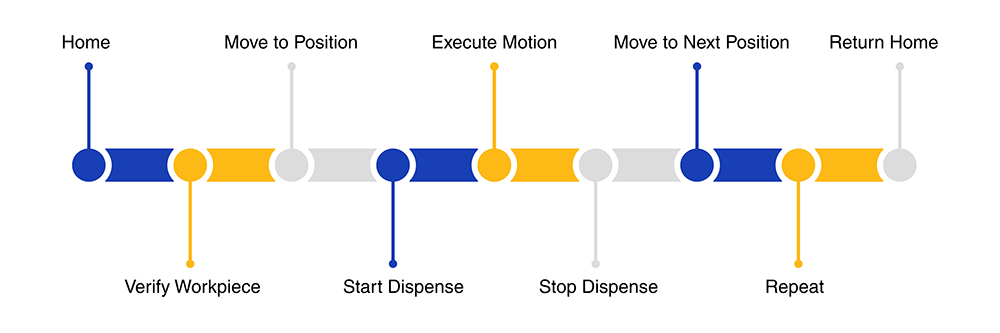
This type of sequence can be stored in the controller rather than relying on a continuously connected PC.
The controller also supports features such as index-on-the-fly and output-on-the-fly. Output-on-the-fly can be used to trigger an output at a defined absolute position during an indexing move, which can be useful when an external machine function needs to be synchronized with motor position.
Where Do the PCL602 and PCL602USB Fit in an OEM Design?
The controllers can be particularly well-suited to machines with a relatively defined motion sequence and a limited number of axes. Potential applications include:
- Automated dispensing equipment
- Pick-and-place machinery
- Labeling equipment
- Inspection and measurement systems
- Small-format positioning systems
- Laboratory automation equipment
- Material handling equipment
- Automated cutting or marking systems
- Packaging machinery
- Two-axis indexing equipment
The key consideration is whether the machine can be effectively controlled using two independent stepper axes and the controller's available I/O and programming capabilities.
For a simple two-axis machine, using a dedicated programmable controller can provide the necessary motion and sequencing functionality without requiring an unnecessarily complex control architecture.
What Are the Differences Between the PL602 the PCL602USB?
The primary difference between the two models is their communication interface. The PCL602 utilizes RS232/RS485 communication and the PCL602USB, as you might guess, utilizes USB communication. Both controllers are powered from DC voltage and are designed for compact machine-control applications.
| Feature | PCL602 | PCL602USB |
| Axes | 2 | 2 |
| Step Rate | Up to 50 kHz | Up to 50 kHz |
| Encoder Feedback | Both axes | Both axes |
| Stored Programming | 2 KB | 2 KB |
| Programmable Outputs | 16 | 16 |
| Programmable Inputs | 6 | 6 |
| Analog Input | 0 - 5VDC | 0 - 5VDC |
| Communication | RS232/RS485 | USB |
| Stored Program Operation | Yes | Yes |
Which Model is Best for My Project?
The choice between the two models largely depends on how you need the controller to communicate with the rest of your machine.
The PCL602 may be appropriate when an OEM's architecture already uses RS232 or RS485 communications or when serial communication is preferred for the machine design.
The PCL602USB may be more convenient when a USB connection is preferred for PC-based setup or machine integration. The USB model uses a Windows driver to provide a virtual COM port, allowing serial programs to communicate with the controller through a computer's USB port.
Both models use Anaheim Automation's SMC62WIN software for programming and direct motion control, with the software available for the PCL602 and PCL602USB.
Designed for OEM Motion Control Applications
For OEMs and design engineers, the value of the PCL602 and PCL602USB is not simply their ability to control two stepper motors. Their combination of programmable motion, encoder feedback, machine I/O, stored sequences, and communication capabilities allows them to serve as the central motion-control element in a variety of compact automated machines.
When an application requires two independent stepper axes, repeatable positioning, machine sequencing, and feedback, but does not necessarily require a more complex multi-axis control architecture, the PCL602 and PCL602USB provide a practical option to consider.
Both models are part of Anaheim Automation's programmable stepper controller family, which includes single- and dual-axis controllers and supports applications ranging from individual machine axes to larger multi-axis systems. Anaheim Automation's programmable controller family is designed and manufactured in the USA.