We use cookies to make your experience better. To comply with the new e-Privacy directive, we need to ask for your consent to set the cookies. Learn more.

HMI/PLC Combo Units: Simplifying Machine Control with Kinco Integrated Automation Solutions
Jun 2026 Nicole Jones
Streamline Your Automation Architecture with Integrated HMI and PLC Technology
As industrial automation systems become more sophisticated, machine designers and OEMs face increasing pressure to reduce panel space, simplify wiring, lower costs, and accelerate development cycles. One solution that continues to gain popularity across manufacturing and machine-building industries is the HMI/PLC Combo, an integrated device that combines a Human Machine Interface (HMI) and Programmable Logic Controller (PLC) into a single compact unit.
Anaheim Automation proudly partners with Kinco Automation to offer these HMI/PLC Combo units designed to deliver powerful machine control and intuitive operator interaction while simultaneously reducing the complexity of traditional control architectures.
Available in both 4.3" and 7" touchscreen configurations, these integrated systems provide a cost-effective and space-saving alternative to separate PLC and HMI installations, making them ideal for OEM equipment, packaging machinery, material handling systems, process automation equipment, and countless other industrial applications.
What Is an HMI/PLC Combo?
Traditionally, automation systems utilize separate PLCs and HMIs connected through serial or Ethernet communications. The PLC executes machine logic while the HMI provides visualization, monitoring, and operator control.
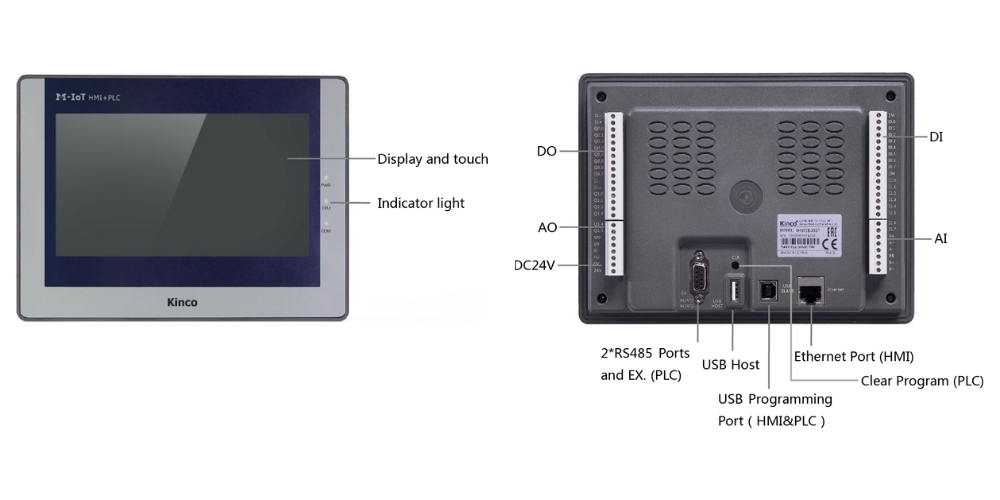
An HMI/PLC combo integrates both functions into a single device:
- PLC processing and I/O management
- Operator interface and visualization
- Communications functionality
- Vivid touchscreen display
- Reduced hardware requirements
By combining these functions into one platform, machine builders can simplify system design while maintaining reliable control performance.
Key Benefits of Integrated HMI/PLC Solutions
Reduced Wiring Complexity
One of the most significant advantages of an HMI/PLC Combo is the dramatic reduction in wiring requirements. With separate devices, engineers must install PLC power wiring, HMI power wiring, communication cables between devices, and additional mounting hardware.
By integrating both systems into a single unit, communication between HMI and PLC occurs internally, eliminating many potential wiring and communication issues. Benefits include:
- Faster installation
- Simplified troubleshooting
- Reduced labor costs
- Cleaner control panel layouts
- Fewer connection points that can fail
Smaller Control Cabinets
Control cabinet real estate is often at a premium. Replacing a standalone PLC, HMI, communication hardware, and associated wiring with a single integrated device can significantly reduce required panel space.
This is especially valuable for:
- Compact machinery
- Mobile equipment
- Skid-mounted systems
- Distributed automation systems
- Retrofit projects
Smaller cabinets often translate into lower material costs and improved thermal management.
Faster Machine Development
Integrated HMI/PLC platforms simplify system architecture, enabling engineers to:
- Reduce component selection time
- Minimize integration challenges
- Accelerate commissioning
- Simplify documentation
For OEMs producing multiple machine variants, this can help reduce engineering hours and shorten time-to-market.
Lower Overall System Cost
Combining multiple automation functions into a single unit often reduces:
- Hardware costs
- Installation costs
- Wiring expenses
- Inventory requirements
- Spare parts management
The result is a more economical automation solution without sacrificing functionality.
Are There Any Drawbacks?
Like any engineering solution, HMI/PLC Combo units involve certain tradeoffs.
Limited Modularity
With separate PLC and HMI devices, either component can be upgraded independently. An integrated unit combines both functions into one package, meaning upgrades typically involve replacing the entire device. The positive side? For many OEM applications, machine designs remain stable for years. The simplified architecture, lower component count, and reduced maintenance requirements often outweigh the benefits of independent upgrades.
Best-Suited for Small-to-Medium Control Systems
Extremely large automation systems with hundreds of I/O points or extensive networking requirements may still benefit from dedicated PLC platforms. However, the majority of machine automation applications fall within the ideal performance range of integrated HMI/PLC solutions, making them an excellent choice for OEM equipment and standalone machinery.
Kinco HMI/PLC Combo Models from Anaheim Automation
Anaheim automation offers three powerful integrated HMI/PLC solutions designed for a wide range of automation applications.
KNC-HMI-MK043E-20DT
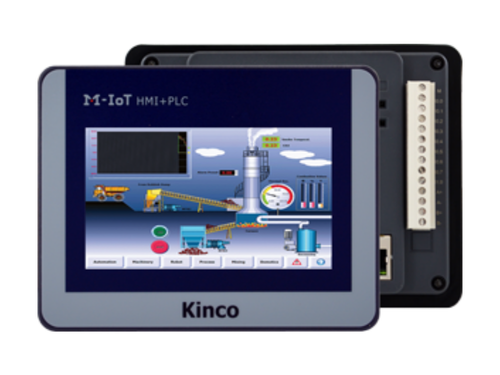
The MK043E-20DT combines a vibrant 4.3 inch TFT touchscreen interface with built-in PLC functionality, making it an ideal solution for compact machine designs.
Key Features
- 4.3" TFT touchscreen display
- Integrated PLC functionality
- 20 digital I/O points
- High-speed processing
- Industrial communications support
- Ideal for space-constrained control systems
Recommended Applications
- Small packaging and labeling machines
- Conveyor controls
- Automated test stations
- Assembly fixtures
- Compact material handling systems
Its small size makes it especially attractive for OEMs seeking to maximize functionality while minimizing panel space.
KNC-HMI-MK043E-20DTC
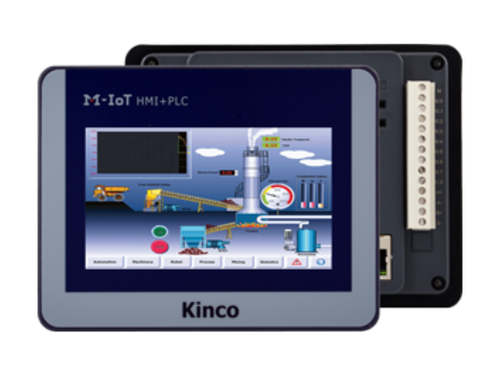
The MK043E-20DTC builds on the capabililties of the MK043E-20DT by incorporating enhanced communication flexibility for more connected industrial environments.
Key Features
- 4.3" touchscreen interface
- Integrated PLC control
- 20 onboard I/O points
- Expanded communication capabilities
- Compact panel footprint
- Simplified system integration
Recommended Applications
- Networked machine systems
- Smart manufacturing equipment
- Distributed automation cells
- Industrial monitoring systems
- Remote machine control applications
This model is particularly well-suited for OEMs embracing Industry 4.0 initiatives and connected manufacturing environments.
KNC-HMI-MK070E-33DT
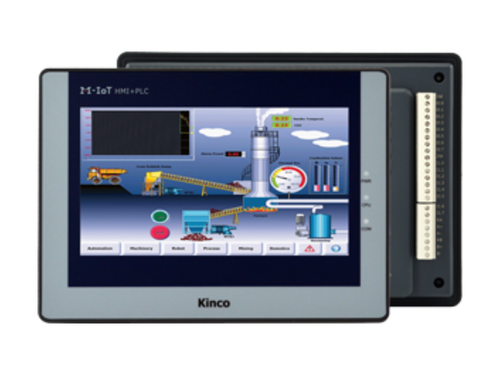
With additional screen space and expanded I/O capacity, the MK070E-33DT delivers an excellent balance of operator visibility and machine control performance.
Key Features
- 7" color touchscreen display
- Integrated PLC controller
- 33 digital I/O points
- Enhanced operator visualization
- Larger graphical interface
- Industrial-grade reliability
Recommended Applications
- Packaging systems
- Food processing equipment
- Automated assembly machines
- Industrial proccess control
- OEM production machinery
The larger display allows operators to view more process data simultaneously while simplifying machine interaction.
Industries that Benefit from HMI/PLC Combo Technology
Kinco HMI/PLC Combo units are versatile solutions that can be deployed across a wide range of industries.
Packaging Automation |
Material Handling |
Food and Beverage |
Water and Wastewater Equipment |
Agriculture Equipment |
General OEM Machinery |
 |
 |
 |
 |
 |
 |
|
|
|
|
|
|
The growing demand for smaller, smarter, and more cost-effective automation systems continues to drive adoption of integrated HMI/PLC technology. By combining machine control and operator interface functions, Kinco HMI/PLC Combo units help OEMs and design engineers reduce wiring, conserve panel space, lower costs, and accelerate machine development.
From compact 4.3" models such as the KNC-HMI-MK043E-20DT and KNC-HMI-MK043E-20DTC to the larger and more powerful KNC-HMI-MK070E-33DT, Anaheim Automation offers integrated automation solutions that simplify machine design while delivering reliable industrial performance.
For OEMs seeking streamlined control architectures and faster deployment, HMI/PLC Combo units represent an intelligent step toward more efficient machine automation.
FAQs
What is an HMI/PLC Combo?
An HMI/PLC Combo is an integrated automation device that combines a Human Machine Interface (HMI) and a Programmable Logic Controller (PLC) into a single unit. This design allows operators to monitor and control machinery through a touchscreen interface while the built-in PLC executes machine logic and automation tasks.
What are the advantages of using an HMI with an integrated PLC?
HMI/PLC Combo units offer several benefits, including:
- Reduced wiring and installation time
- Smaller control cabinet footprint
- Fewer communication points and potential failure sources
- Lower overall system costs
- Faster machine design and commissioning
- Simplified maintenance and troubleshooting
What industries commonly use HMI/PLC Combo Units?
Integrated HMI/PLC solutions are widely used across industries such as:
- Packaging and labeling
- Material handling and conveyor systems
- Food and beverage processing
- Water and wastewater treatment
- Agriculture and irrigation
- Assembly automation
- Inspection and test equipment
- General industrial machinery
What is the difference between the KNC-HMI-MK043E-20DT and the KNC-HMI-MK043E-20DTC?
Both models feature a 4.3-inch touchscreen and integrated PLC functionality with 20 digital I/O points. The KNC-HMI-MK043E-20DTC offers enhanced communication capabilities, making it ideal for applications requiring additional connectivity and network integration.
When should I choose the KNC-HMI-MK070E-33DT?
The KNC-HMI-MK070E-33DT is ideal for applications requiring:
- A larger 7-inch touchscreen interface
- Increased visualization of machine data
- Additional I/O capacity
- More advanced operator interaction
Can HMI/PLC Combo units help reduce control panel size?
Yes. By combining the HMI and PLC into a single device, integrated units eliminate the need for separate hardware, communication cables, and mounting space. This can significantly reduce panel size and simplify control cabinet layouts.
Are HMI/PLC Combo units suitable for OEM machine builders?
Absolutely. OEMs often benefit from reduced component counts, simplified wiring, faster assembly, and lower manufacturing costs. Integrated HMI/PLC units can also help standardize machine designs across product lines.
Can Kinco HMI/PLC Combo units communicate with other devices?
Yes. Kinco HMI/PLC Combo units support industrial communications that allow them to interface with devices such as:
- Variable Frequency Drives (VFDs)
- Servo systems
- Sensors and I/O modules
- Industrial networks
- SCADA systems